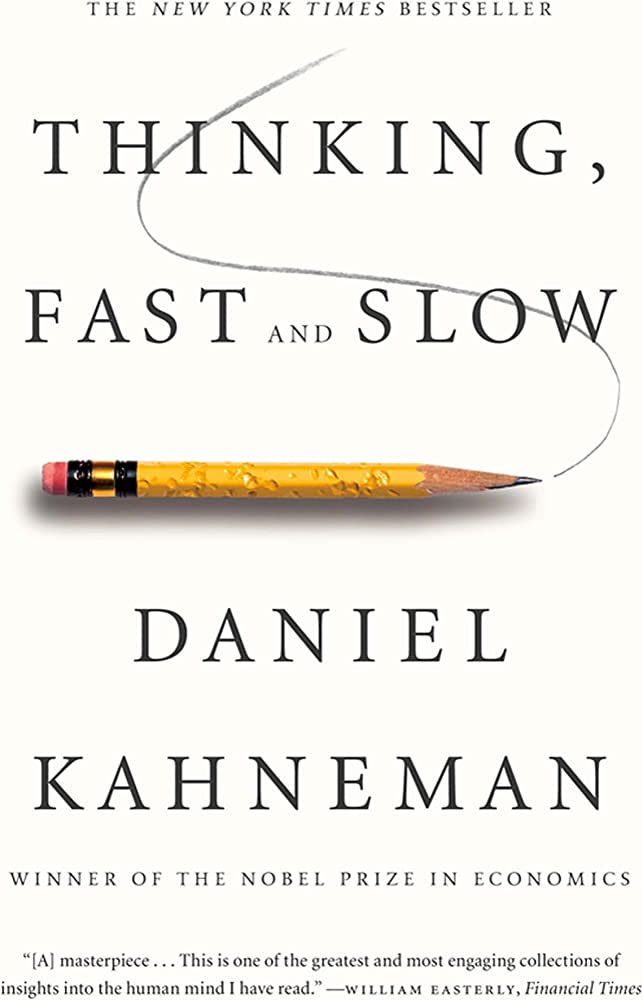
Thinking, Fast and Slow is a fascinating book written by Daniel Kahneman, a renowned psychologist and Nobel Prize winner in economics. The book is an exploration of the cognitive biases that people encounter in their everyday lives and how they affect decision making. Kahneman presents the human mind as having two distinct modes of thinking: System 1, which operates quickly and automatically, and System 2, which is slower and more deliberate.
“We are confident when the story we tell ourselves comes easily to mind, with no contradiction and no competing scenario. But ease and coherence do not guarantee that a belief held with confidence is true.”
Daniel Kahneman

The book is divided into five parts, each of which explores different aspects of human cognition. In Part One, Kahneman introduces the concept of two systems of thinking and describes how they interact with each other. System 1 is the default mode of thinking that operates automatically and effortlessly, while System 2 requires conscious effort and attention. Kahneman shows how these two systems work together to make decisions, and how they can sometimes lead to errors in judgment.
In Part Two, Kahneman discusses the concept of heuristics, which are mental shortcuts that people use to make decisions. Heuristics can be helpful in many situations, but they can also lead to cognitive biases that affect decision making. Kahneman describes several common heuristics, such as availability bias, which is the tendency to judge the likelihood of an event based on how easily it comes to mind. Other heuristics that Kahneman discusses include representativeness bias, anchoring bias, and confirmation bias.
In Part Three, Kahneman explores the impact of cognitive biases on decision making in specific contexts, such as finance, medicine, and sports. He shows how cognitive biases can affect investment decisions, medical diagnoses, and even the outcomes of sports matches. Kahneman argues that understanding these biases is essential for making better decisions in these domains.
In Part Four, Kahneman describes the concept of prospect theory, which is a model of decision making that takes into account the psychological factors that influence people’s choices. He explains how people’s perceptions of gains and losses affect their decision making, and how this can lead to irrational choices. Kahneman also discusses the concept of loss aversion, which is the tendency to avoid losses more than seeking gains.
Finally, in Part Five, Kahneman considers the implications of his research for the broader fields of psychology and economics. He argues that traditional models of economic behavior, which assume that people always act rationally, do not accurately reflect human decision making. Instead, Kahneman suggests that economists should take into account the cognitive biases that people experience when making decisions.
Overall, Thinking, Fast and Slow is an engaging and thought-provoking book that challenges readers to think more critically about their own thinking processes. Kahneman’s insights into the ways in which cognitive biases can affect decision making have important implications for many areas of life, from personal finance to public policy. The book is a must-read for anyone who wants to understand the complexities of human decision making and the ways in which our minds can sometimes deceive us.
 Book Movie Technology Reviews Fitness Wellness Health Tips